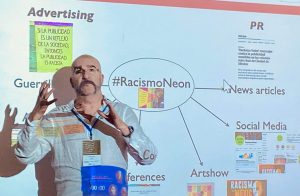
Prof. Miriyam Aouragh speaks at NYU, CUNY in U.S. lecture tour
In a series of lectures in New York, Prof. Miriyam Aouragh discussed digital infrastructures, political conflict, higher education, and solidarity.
At New York University on November 18th, Prof. Aouragh discussed her paper “Propaganda in Times of Genocide.” Organized by the Critical Racial Anti-Colonial Study Co-Lab and co-Sponsored: NYU’s Kevorkian Center, her lecture explored how digital infrastructures afford an ecology in which genocide cannot be hidden away, explaining that with every publicly live-streamed urban bombing and assassination, its moral neglect is laid bare. Debates about how digital technologies absorb ‘traditional’ political conflicts have intensified in recent years. Through the lecture Aouragh offered a longitudinal reflection on Hasbara, a mixture of propaganda and public diplomacy, through recent research in light of the genocide and by returning to her earlier analyses about Palestine activism and assertions about the implications of Hasbara ten years ago.
In a second lecture, hosted by the Department of Urban Education at the Graduate Center at the City University of New York (CUNY), Aouragh addressed the dynamics, struggles, and obligations of universities collaborating with movements on the ground in times of global struggle. She posed the questions: How do we rethink solidarity in times of genocide? What is the ideological agenda of a politics fueled by hierarchies of oppression? Where can we locate the ruptures created along race, class, gender and sexuality and replace those with a Radical Kinship that gives meaning to the adage “Nobody is Free Until Everybody is Free”? The event was also sponsored by the CUNY’s Department of Critical Psychology and the Public Science Project along with several additional departments, including CUNY’s Middle East and Middle Eastern American Center.
Photo by Claudio Schwarz on Unsplash