PhD Symposium brings together London’s media and communication doctoral research community
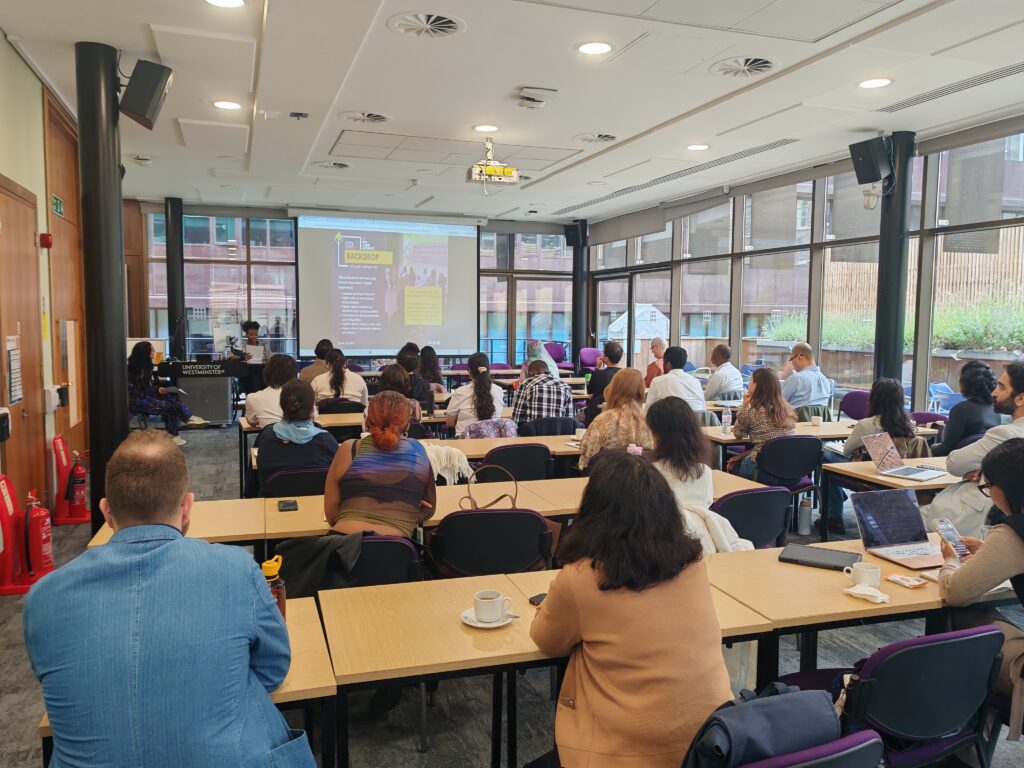
On Friday 11 September, the School of Media and Communication hosted its annual PhD Symposium at the Cavendish campus, bringing together doctoral researchers from across London for a day of discussion, exchange and networking. Now in its fourth post-COVID edition, the symposium continues to provide an important forum for emerging researchers in the field to share their work and build connections across institutions.
Organised by Alessandro D’Arma and Ed Bracho-Polanco in collaboration with doctoral researchers and colleagues from five other London-based universities – City St George’s, Goldsmiths, the London School of Economics and Political Science (LSE), SOAS and University College London (UCL) – the all-day event welcomed more than 50 attendees. Thirty doctoral researchers presented their work across six thematic panels, showcasing the remarkable breadth and diversity of research currently being undertaken in media and communication, spanning journalism, gender, politics, urban studies, digital cultures and social change.
The symposium opened with a panel exploring ‘Power, Knowledge and the Politics of Representation’, examining the ways in which digital media, knowledge and representation intersect with questions of power. This was followed by a panel on ‘Gendered Contestations: Anti-Feminist Mobilisations, Feminist Resistance and Marginalised Subjectivities’, highlighting research into contemporary gender politics, resistance and marginalised voices.
The third panel, ‘Journalistic Institutions and Practices: Challenges, Adaptation, and Innovation’, focused on the changing nature of journalism and the challenges and opportunities facing journalistic institutions and practitioners. The fourth panel turned to questions of space and place, with Producing, Imagining and Inhabiting Urban Space exploring the relationship between media, culture and the urban environment.
The final two panels broadened the discussion to questions of collective action and digital life. ‘Participation, Solidarity and Social Change’ brought together research examining participation and forms of social and political engagement, while ‘Digital Cultures, Identities and Everyday Life’ considered the growing significance of digital media and cultures in shaping identities and everyday experiences.
Across all six panels, presentations generated lively Q&A discussions, providing speakers with constructive feedback. Beyond the formal presentations, the symposium provided an important opportunity for doctoral researchers to meet peers working on related questions at other London universities. For many participants, these informal conversations were as valuable as the panel discussions themselves, helping to strengthen a growing London-wide PhD research community.
The School is pleased to have hosted another successful edition of the symposium and to be part of an expanding network of London universities committed to supporting dialogue, collaboration and exchange among the next generation of media and communication researchers.
Photo: Alessandro D’Arma