Doug Specht’s Ukraine research brings local voices into the reconstruction debate

Dr Doug Specht, Reader in Cultural Geography and Communication at the University of Westminster, has been working with Elena Orap and Rob Sharp to examine how communities in Ukraine experience reconstruction and why smaller settlements risk being overlooked, as explored in their recent article for The Conversation. Their collaborative StoryMap, “My place of power is my house”, places residents’ accounts of Makariv at the centre of this work, documenting the everyday realities of rebuilding lives as well as infrastructure.
Mapping life beyond the damage
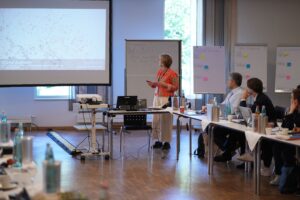
The research draws on participatory mapping workshops held with 30 people in Makariv in July 2025, organised by Sharp, Orap and the local council, with support from the University of Westminster, as detailed in the StoryMap’s account of the fieldwork. Working around large printed maps, participants recorded places of personal importance and discussed destruction, belonging and how their community should remember those killed in the war, contributing testimony and mapped knowledge to the collaborative project.
Available in English and Ukrainian, the StoryMap brings these accounts together with photographs and mapping, exploring the importance of homes and parks alongside the disruption caused by damaged transport connections. Its emphasis is on what rebuilding means to the people who live there, rather than treating recovery solely as the repair of physical assets.
Who gets counted in reconstruction?
In “The unseen geography of Ukraine’s reconstruction”, published by Geographical, Specht connects these everyday experiences to a wider question: how do communities make their needs visible to the institutions allocating reconstruction resources? His argument shifts attention from the visibility of destruction to the less visible work of documenting needs in forms that funding systems can recognise.
Writing together in The Conversation, Specht, Orap and Sharp examine the administrative demands placed on local authorities, reporting that nearly half of Makariv’s 70 projects registered on Ukraine’s DREAM platform lacked a costed amount at the time of their analysis. As the authors argue, the concern is not digital reconstruction itself, but unequal capacity to participate: councils need staff, expertise and resources to turn local needs into the records and proposals on which investment depends.
Read alongside the residents’ accounts, this analysis raises a question central to the relationship between communication, knowledge and power: whose experience becomes evidence, and whose remains outside the record? The challenge is not simply to produce more detailed maps, but to ensure that the people living through reconstruction can help define what recovery should mean.
Photo by Diana Vyshniakova on Unsplash